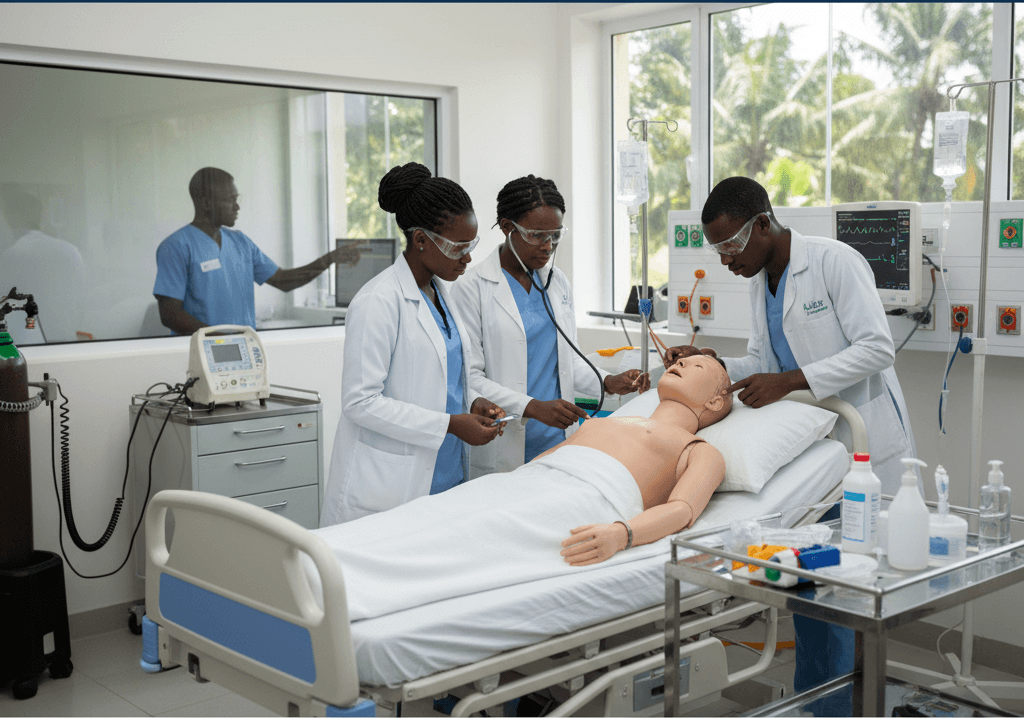
At Kaive International Training College, our dedication to high-quality, hands-on training is evident in every aspect of our curriculum—and nowhere is this clearer than in our cutting-edge simulation labs. We believe that learning the art of healthcare should never be limited to theory. Before our students step into a real clinical setting, they first master their skills in a realistic, safe, and controlled environment.
Simulation labs are more than just fancy classrooms; they are the future of healthcare education. Here’s a look at how Kaive is using this revolutionary technology to produce globally competitive and confident professionals.
The Power of Practice: Safe Space, Real Pressure
The core value of our simulation labs is the ability to practice, fail, and learn without risk to a patient. Healthcare is high-stakes, and mistakes are simply not an option in the real world. Our labs allow students to:
- Practice High-Risk Procedures: Students can repeat critical procedures—like IV insertions, administering emergency medication, or wound care—until they achieve absolute proficiency, building the muscle memory necessary for fast and accurate action.
- Handle Rare Emergencies: Simulators can recreate rare or acute crises that students might not encounter during typical clinical rotations. Trainees learn to respond effectively to cardiac arrests, anaphylaxis, or childbirth complications, ensuring they are prepared for the unexpected.
- Refine Critical Thinking: Simulation scenarios aren’t just about technical skills; they are designed to challenge the student’s critical thinking and decision-making under pressure. When the “patient” suddenly deteriorates, students must analyze the situation, prioritize their actions, and communicate effectively, mirroring the complexities of a real hospital environment.
From Mannequin to “Patient”: High-Fidelity Training
Our labs utilize high-fidelity simulators—advanced mannequins that can be programmed to display lifelike symptoms. These simulators can:
- Talk, breathe, and have pulses: They react physiologically to interventions, requiring students to monitor vital signs, assess pupil dilation, and listen to lung or heart sounds, just as they would with a live patient.
- Accept medical treatments: Students can actually inject fluids, perform CPR, and use defibrillators on the mannequins, providing immediate feedback on their technique and decision-making.
This level of realism helps students bridge the gap between abstract knowledge and practical application, ensuring they are not surprised by the sights, sounds, and feel of actual patient care.
Beyond the Clinical: Teamwork and Professionalism
Simulation training at Kaive is a collaborative experience. It does much more than just train individual students:
- Enhances Teamwork: Many scenarios require students to work together as a healthcare team, mimicking a ward or trauma unit. They practice effective communication, delegation, and coordination—essential soft skills in a multi-disciplinary healthcare environment.
- Provides Objective Feedback: All simulation sessions are typically recorded and observed. This allows the instructor to lead a detailed debriefing session afterward, where the student’s performance can be reviewed objectively. This constructive feedback accelerates learning faster than traditional clinical observation alone.
- Builds Confidence: By successfully navigating challenging scenarios in the lab, Kaive graduates develop the professional confidence necessary to handle real-world situations calmly and expertly.
At Kaive International Training College, our simulation labs are proof of our mission: to provide innovative and practical training that empowers our learners. We’re not just reading chapters; we’re crafting competent, ready-to-work professionals who are prepared to excel from day one.