In the dynamic and ever-evolving field of healthcare, theoretical knowledge alone is simply not enough. At Kaive International Training College, we firmly believe that practical training is the cornerstone of effective healthcare education, transforming aspiring students into competent, confident, and compassionate professionals ready to make a real impact.
Healthcare is a hands-on profession. Whether it’s administering medication, performing diagnostic tests, assisting in surgical procedures, or providing patient care, every action requires precision, skill, and a deep understanding that can only be gained through direct experience. Our TVET-certified institution is built upon this very principle, ensuring our students don’t just learn about healthcare, but actively learn how to do healthcare.
Why is practical training so critical in healthcare education?
- Bridging the Theory-Practice Gap: Classroom lectures provide foundational knowledge, but it’s in the lab, simulation center, or clinical setting that this knowledge truly comes alive. Students learn to apply complex concepts to real-world scenarios, understanding the nuances that textbooks can’t always convey. They move from understanding what to do, to mastering how to do it safely and effectively.
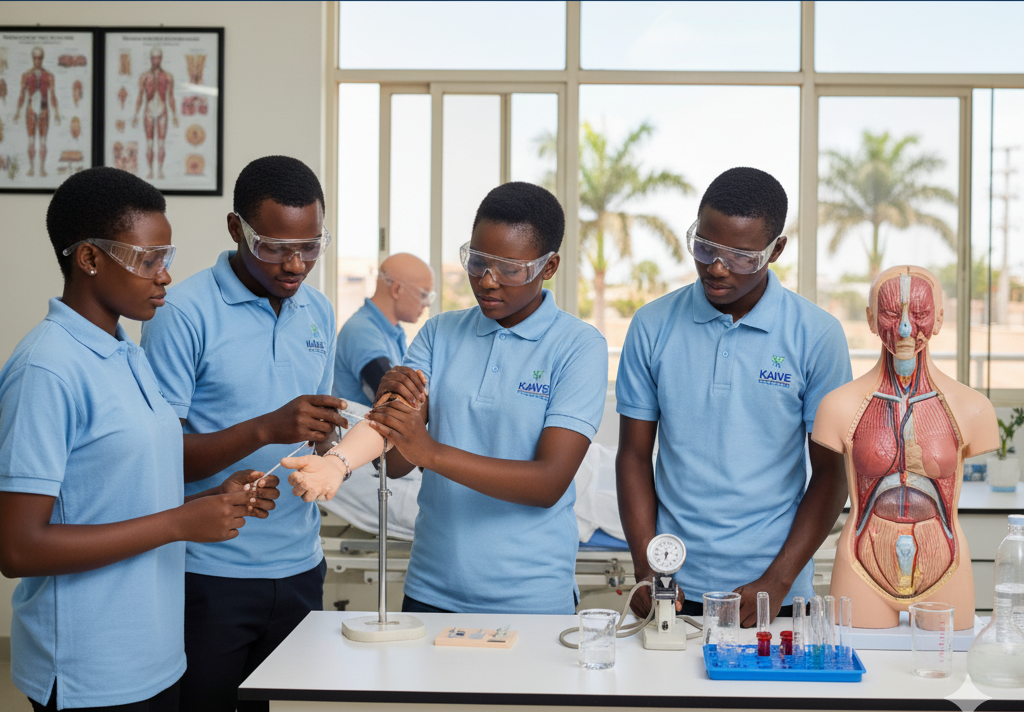
- Developing Essential Technical Skills: From using medical equipment and interpreting results to patient assessment and emergency response, healthcare professionals require a vast array of technical skills. Practical training provides a safe environment to repeatedly practice these skills, building muscle memory and proficiency under the guidance of experienced instructors. This iterative process is vital for achieving the high standards required in patient care.
- Enhancing Critical Thinking and Problem-Solving: Healthcare often presents unexpected challenges. Practical scenarios encourage students to think on their feet, make rapid decisions, and adapt to changing conditions. They learn to critically analyze situations, identify problems, and implement appropriate solutions, skills that are indispensable in a fast-paced clinical environment.
- Building Confidence and Professionalism: There’s a profound difference between knowing a procedure and being able to execute it confidently. Practical training instills the self-assurance necessary to perform duties effectively and interact professionally with patients and colleagues. This early exposure to professional environments helps students cultivate the compassion, ethics, and communication skills vital for a successful career.
- Improving Patient Safety and Outcomes: Ultimately, the goal of all healthcare training is to ensure the best possible patient outcomes. Well-trained professionals, who have honed their skills through extensive practical experience, are less likely to make errors and more likely to provide high-quality, safe care. Kaive International Training College prioritizes this by integrating rigorous practical components throughout our curricula.
At Kaive International Training College, our commitment to hands-on learning goes beyond simulations. We integrate real-world training experiences, allowing our graduates to step into their careers not just with a certificate, but with a robust skillset and the confidence forged in practical application. Our vision is to produce graduates who are not only globally competitive but also profoundly socially responsible, ready to transform lives in their communities.